Technical guides ·
Hospital Waste Sterilizer: On-Site Treatment of Infectious Medical Waste with Microwave Technology (FTS)
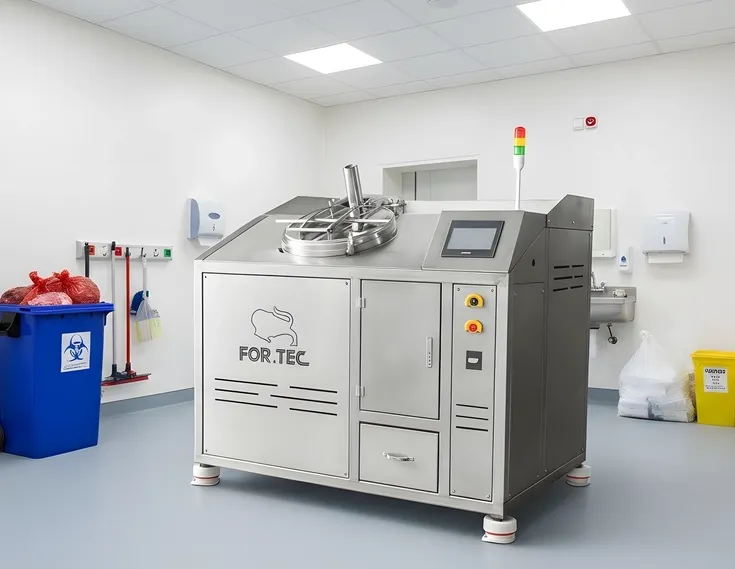
FTS FORTEC hospital waste sterilizer. On site treatment of infectious medical waste with microwave technology, closed and safe cycle.
Properly managing hospital waste is not only a matter of cost and logistics — it is primarily a matter of safety. When dealing with infectious medical waste, every step — storage, internal handling, external transport — increases the number of variables to control and, consequently, the operational risk.
For many healthcare facilities, the most effective solution is to internalize part of the process with an on-site hospital waste sterilizer designed to operate in a closed cycle, with controlled parameters and verifiable results.
The FTS – Integrated Microwave Sterilization and Disinfection system by FORTEC is an advanced solution for treating infectious medical waste, entirely designed and manufactured by the company. The technology integrates high-speed mechanical shredding, saturated steam injection, and microwave irradiation to achieve deep and effective sterilization while keeping the entire process confined and automated.
More product info: Microwave Sterilization for Hospital Waste – FTS
What Is a Hospital Waste Sterilizer and Why On-Site Treatment Matters
A hospital waste sterilizer is a system designed to significantly reduce the microbial load of infectious medical waste, making it safer and easier to handle. In a hospital environment, the advantages of internal treatment are often substantial:
- reduced long-term storage and internal handling;
- lower dependence on external collection schedules;
- greater control over traceability and operational procedures;
- a more linear process with fewer critical points along the chain.
The key factor is repeatability: a well-designed industrial system must operate continuously and maintain stable performance even when processing real, variable waste streams.
Microwave Sterilization: How It Works and Why It Is Effective on Medical Waste
The FTS system operates at 2,450 ± 50 MHz, a standardized industrial frequency in the ISM band (Industrial, Scientific, Medical), widely used in disinfection and sterilization processes due to its effectiveness and volumetric heating capability.
Thermal Effect: Dielectric Heating Within the Waste Mass
Microwaves interact with polar molecules (especially water), generating a rapid temperature increase. Unlike heating by contact or conduction alone, heat is produced more uniformly throughout the treated mass, offering significant benefits in terms of consistency.
Non-Thermal Effects: Electrophysical and Biological Contributions
Beyond heat, microwaves may contribute to microbial inactivation through direct cellular effects: membrane permeability alteration, changes in electrochemical potentials, and possible interactions with proteins and enzymes.
Why a Microwave Sterilizer Can Outperform Traditional Systems
When comparing a microwave-based hospital waste sterilizer with traditional systems (e.g., steam autoclaves, chemical treatments, or non-integrated thermal processes), the difference lies not only in the energy source but in how the process acts on the waste.
Medical waste is heterogeneous: different materials, variable density, inconsistent moisture, irregular shapes, and components that may shield heat transmission. In these conditions, an integrated shredding + steam + microwave system offers practical advantages:
- Volumetric, more uniform heating: microwaves generate heat inside the mass, reducing the risk of untreated zones when the material is compact or inconsistent.
- Greater repeatability on mixed waste: shredding increases homogeneity and surface area; saturated steam stabilizes moisture; microwaves complete the cycle with energy distributed across a prepared material.
- Closed cycle, no chemical reagents: unlike chemical treatments, it avoids managing reagents or neutralizers and reduces operational variables.
- On-site treatment and fewer movements: fewer transports and external storage steps mean fewer critical points in terms of biosafety and daily management.
- Optimized operating times: in traditional systems, performance depends heavily on load configuration and heat penetration. An integrated system reduces the impact of these variables by controlling them upstream.
In short: the difference is not microwaves vs. steam in absolute terms, but microwaves + waste preparation + moisture control in a closed cycle specifically designed for infectious medical waste.
FTS FORTEC: Closed-Cycle Operation (Automatic and Confined)
The FTS process is designed to be sealed and automated, preventing operator exposure and reducing the risk of dispersion.
Main Process Steps
- Manual or automatic loading of waste into suitable containers
- High-speed mechanical shredding
- Controlled injection of saturated steam
- Microwave irradiation through waveguide
- Simultaneous internal/external thermal treatment
- Cooling and optional compaction of treated material
This sequence ensures stable operation even with mixed waste, optimizing moisture and homogeneity before irradiation.
Microbiological Effectiveness: Up to ≥ 8 log10 Reduction in Validated Conditions
The FTS system is designed to support microbial inactivation up to ≥ 8 log10 in validated conditions, including spore-forming strains such as Geobacillus stearothermophilus, following protocols aligned with EN ISO 11138 and WHO technical references.
Emission Treatment: Vapors and VOCs Managed with Multi-Stage Filtration
During the cycle, vapors and gases (humidity and volatile organic compounds – VOCs) may be released. FTS manages emissions through a negative-pressure extraction circuit with:
- mechanical pre-filtration;
- HEPA filtration;
- UV-C photolysis;
- activated carbon filtration.
This ensures safe and comfortable operation within internal technical areas.
Technical Features and Operational Advantages
- High-efficiency sterilization (up to ≥ 8 log10 in validated conditions) with certified biological indicators
- Fully sealed and safe cycle
- AISI 304 stainless steel construction
- Industrial control with Siemens PLC and HMI
- Low routine maintenance
- Compact, modular layout suitable for hospital infrastructures
- Certified according to ISO 9001:2015, ISO 14001:2015, ISO 45001:2018
When It Makes Sense to Install an On-Site Hospital Waste Sterilizer
An internal system like FTS is particularly suitable when:
- the facility generates regular volumes of infectious waste;
- reducing exposure linked to storage and handling is a priority;
- greater control over procedures and traceability is required;
- the goal is a more autonomous and organized management of biological risk.
Conclusion
FTS – Integrated Microwave Sterilization and Disinfection by FORTEC combines three elements that make a real difference in practice: waste preparation (shredding), controlled conditions (steam/moisture), and microwave sterilization in a closed, automated process. It is a modern solution for hospitals, clinics, and laboratories seeking to manage infectious medical waste internally with a system designed for safety, repeatability, and industrial-grade control.
Request information
Contact FORTEC
FAQ – Microwave Hospital Waste Sterilizer
Why is a microwave sterilizer better than traditional systems?
Because with mixed and heterogeneous medical waste, an integrated system (shredding + steam + microwaves) ensures a more uniform and repeatable treatment. Microwaves generate heat inside the mass, shredding reduces density differences, and steam stabilizes moisture to improve heat transfer.
What is the difference compared to a traditional steam autoclave?
Autoclaves are effective, but they are more sensitive to load arrangement and steam penetration. With real medical waste, a system combining shredding and microwaves helps reduce issues related to compact masses and potential treatment inconsistencies.
Is a microwave sterilizer suitable for infectious medical waste?
Yes, especially when it integrates shredding and saturated steam to make the material homogeneous and consistently treatable in a closed, automated cycle.
What level of microbial reduction can be achieved?
In validated conditions, the system is designed to support reductions up to ≥ 8 log10, including spore-forming strains used as biological indicators.
What happens to vapors and odors produced during treatment?
FTS manages emissions through negative-pressure extraction and multi-stage filtration (pre-filtration, HEPA, UV-C, activated carbon) to control vapors and VOCs.
Technical department
Do you need a tailor-made solution?
Tell us what you need: our engineers will work with you on the most suitable plant and send you a customised proposal.